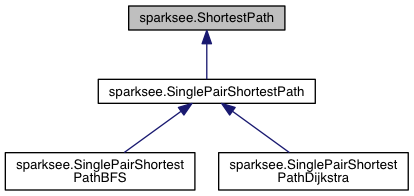
ShortestPath class. More...
Public Member Functions | |
| add_edge_type (self, type, dir) | |
| Allows for traversing edges of the given type. | |
| run (self) | |
| Runs the algorithm. | |
| exclude_nodes (self, nodes) | |
| Set which nodes can't be used. | |
| add_all_edge_types (self, dir) | |
| Allows for traversing all edge types of the graph. | |
| add_node_type (self, type) | |
| Allows for traversing nodes of the given type. | |
| exclude_edges (self, edges) | |
| Set which edges can't be used. | |
| close (self) | |
| Closes the ShortestPath instance. | |
| set_maximum_hops (self, maxhops) | |
| Sets the maximum hops restriction. | |
| add_all_node_types (self) | |
| Allows for traversing all node types of the graph. | |
| is_closed (self) | |
| Gets if ShortestPath has been closed or not. | |
Detailed Description
ShortestPath class.
Classes implementing this abstract class solve the shortest path problem in a graph.
The user must set which node and edge types can be used for the traversal.
Check out the 'Algorithms' section in the SPARKSEE User Manual for more details on this.
Member Function Documentation
◆ add_all_edge_types()
| sparksee.ShortestPath.add_all_edge_types | ( | self, | |
| dir ) |
Allows for traversing all edge types of the graph.
- Parameters
-
dir [in] Edge direction.
Reimplemented in sparksee.SinglePairShortestPath, sparksee.SinglePairShortestPathBFS, and sparksee.SinglePairShortestPathDijkstra.
◆ add_edge_type()
| sparksee.ShortestPath.add_edge_type | ( | self, | |
| type, | |||
| dir ) |
Allows for traversing edges of the given type.
- Parameters
-
type [in] Edge type. dir [in] Edge direction.
Reimplemented in sparksee.SinglePairShortestPath, sparksee.SinglePairShortestPathBFS, and sparksee.SinglePairShortestPathDijkstra.
◆ add_node_type()
| sparksee.ShortestPath.add_node_type | ( | self, | |
| type ) |
Allows for traversing nodes of the given type.
- Parameters
-
type null
Reimplemented in sparksee.SinglePairShortestPath, sparksee.SinglePairShortestPathBFS, and sparksee.SinglePairShortestPathDijkstra.
◆ close()
| sparksee.ShortestPath.close | ( | self | ) |
Closes the ShortestPath instance.
It must be called to ensure the integrity of all data.
◆ exclude_edges()
| sparksee.ShortestPath.exclude_edges | ( | self, | |
| edges ) |
Set which edges can't be used.
This will replace any previously specified set of excluded edges. Should only be used to exclude the usage of specific edges from allowed edge types because it's less efficient than not allowing an edge type.
- Parameters
-
edges [in] A set of edge identifiers that must be kept intact until the destruction of the class.
Reimplemented in sparksee.SinglePairShortestPath, sparksee.SinglePairShortestPathBFS, and sparksee.SinglePairShortestPathDijkstra.
◆ exclude_nodes()
| sparksee.ShortestPath.exclude_nodes | ( | self, | |
| nodes ) |
Set which nodes can't be used.
This will replace any previously specified set of excluded nodes. Should only be used to exclude the usage of specific nodes from allowed node types because it's less efficient than not allowing a node type.
- Parameters
-
nodes [in] A set of node identifiers that must be kept intact until the destruction of the class.
Reimplemented in sparksee.SinglePairShortestPath, sparksee.SinglePairShortestPathBFS, and sparksee.SinglePairShortestPathDijkstra.
◆ is_closed()
| sparksee.ShortestPath.is_closed | ( | self | ) |
Gets if ShortestPath has been closed or not.
- See also
- close()
- Returns
- TRUE if the ShortestPath instance has been closed, FALSE otherwise.
◆ run()
| sparksee.ShortestPath.run | ( | self | ) |
Runs the algorithm.
This method can only be called once.
Reimplemented in sparksee.SinglePairShortestPath, sparksee.SinglePairShortestPathBFS, and sparksee.SinglePairShortestPathDijkstra.
◆ set_maximum_hops()
| sparksee.ShortestPath.set_maximum_hops | ( | self, | |
| maxhops ) |
Sets the maximum hops restriction.
All paths longer than the maximum hops restriction will be ignored.
- Parameters
-
maxhops [in] The maximum hops restriction. It must be positive or zero. Zero, the default value, means unlimited.
Reimplemented in sparksee.SinglePairShortestPath, sparksee.SinglePairShortestPathBFS, and sparksee.SinglePairShortestPathDijkstra.
Generated by
 1.16.1