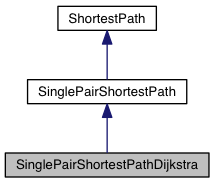
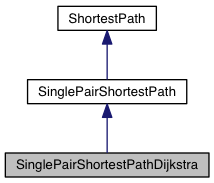
SinglePairShortestPathDijkstra class. More...
#include <SinglePairShortestPathDijkstra.h>
Public Member Functions | |
| virtual | ~SinglePairShortestPathDijkstra () |
| Destructor. | |
| virtual void | Run () |
| Executes the algorithm. | |
| virtual sparksee::gdb::OIDList * | GetPathAsNodes () |
| Gets the shortest path between the source node and the destination node as an ordered set of nodes. | |
| virtual sparksee::gdb::OIDList * | GetPathAsEdges () |
| Gets the shortest path between the source node and the destination node as an ordered set of edges. | |
| virtual sparksee::gdb::double64_t | GetCost () |
| Gets the cost of the shortest path. | |
| SinglePairShortestPathDijkstra (sparksee::gdb::Session &session, sparksee::gdb::oid_t src, sparksee::gdb::oid_t dst) | |
| Creates a new instance. | |
| virtual void | AddWeightedEdgeType (sparksee::gdb::type_t type, sparksee::gdb::EdgesDirection dir, sparksee::gdb::attr_t attr) |
| Allows for traversing edges of the given type using the given attribute as the weight. | |
| virtual void | SetUnweightedEdgeCost (sparksee::gdb::double64_t weight) |
| Sets the weight assigned to the unweighted edges. | |
| virtual void | SetDynamicEdgeCostCallback (SinglePairShortestPathDijkstraDynamicCost *dynCostCalculator) |
| Set a class callback to dynamically calculate the cost of the edges. | |
| virtual sparksee::gdb::bool_t | Exists () |
| Returns TRUE If a path exists or FALSE otherwise. | |
| void | SetMaximumHops (sparksee::gdb::int32_t maxhops) |
| Sets the maximum hops restriction. | |
| virtual void | AddEdgeType (sparksee::gdb::type_t type, sparksee::gdb::EdgesDirection dir) |
| Allows for traversing edges of the given type. | |
| virtual void | AddAllEdgeTypes (sparksee::gdb::EdgesDirection dir) |
| Allows for traversing all edge types of the graph. | |
| virtual void | AddNodeType (sparksee::gdb::type_t type) |
| Allows for traversing nodes of the given type. | |
| virtual void | AddAllNodeTypes () |
| Allows for traversing all node types of the graph. | |
| virtual void | ExcludeNodes (sparksee::gdb::Objects &nodes) |
| Set which nodes can't be used. | |
| virtual void | ExcludeEdges (sparksee::gdb::Objects &edges) |
| Set which edges can't be used. | |
Protected Attributes | |
| sparksee::gdb::oid_t | source |
| Source node. | |
| sparksee::gdb::oid_t | destination |
| Destination node. | |
| sparksee::gdb::OIDList * | pathAsNodes |
| Ordered set of node identifiers representing the shortest path. | |
| sparksee::gdb::OIDList * | pathAsEdges |
| Ordered set of edge identifiers representing the shortest path. | |
| sparksee::gdb::Session * | sess |
| Session. | |
| sparksee::gdb::Graph * | graph |
| Graph. | |
| std::map< sparksee::gdb::type_t, sparksee::gdb::EdgesDirection > | edgeTypes |
| Allowed edge types. | |
| std::vector< sparksee::gdb::type_t > | nodeTypes |
| Allowed node types. | |
| sparksee::gdb::int32_t | maxHops |
| Maximum hops restriction. | |
| sparksee::gdb::bool_t | computed |
| True if the shortest path has been calculated. | |
| sparksee::gdb::Objects * | excludedNodes |
| The set of excluded nodes. | |
| sparksee::gdb::Objects * | excludedEdges |
| The set of excluded edges. | |
| sparksee::gdb::bool_t | areAllNodeTypesAllowed |
| True if all the node types are allowed. | |
Detailed Description
SinglePairShortestPathDijkstra class.
It solves the single-pair shortest path problem using a Dijkstra-based implementation.
It is a weighted algorithm, so it takes into account the cost of the edges to compute a minimum-cost shortest path. That is, the user may set for each edge type which attribute should be used to retrieve the cost of the edge. If no attribute is given for an edge type, this will assume the edge has a fixed cost (the default is 1). Only numerical attribute can be set as weight attributes (that is Long, Integer or Double attributes are allowed).
Check out the 'Algorithms' section in the SPARKSEE User Manual for more details on this.
Constructor & Destructor Documentation
◆ SinglePairShortestPathDijkstra()
| SinglePairShortestPathDijkstra::SinglePairShortestPathDijkstra | ( | sparksee::gdb::Session & | session, |
| sparksee::gdb::oid_t | src, | ||
| sparksee::gdb::oid_t | dst ) |
Creates a new instance.
- Parameters
-
session [in] Session to get the graph from and perform traversal. src [in] Source node. dst [dst] Destination node.
Member Function Documentation
◆ AddAllEdgeTypes()
|
virtualinherited |
Allows for traversing all edge types of the graph.
- Parameters
-
dir [in] Edge direction.
◆ AddEdgeType()
|
virtualinherited |
Allows for traversing edges of the given type.
- Parameters
-
type [in] Edge type. dir [in] Edge direction.
◆ AddWeightedEdgeType()
|
virtual |
Allows for traversing edges of the given type using the given attribute as the weight.
- Parameters
-
type [in] Edge type. dir [in] Edge direction. attr [in] Attribute to be used as the weight. It must be a global attribute or an attribute of the given edge type.
◆ ExcludeEdges()
|
virtualinherited |
Set which edges can't be used.
This will replace any previously specified set of excluded edges. Should only be used to exclude the usage of specific edges from allowed edge types because it's less efficient than not allowing an edge type.
- Parameters
-
edges [in] A set of edge identifiers that must be kept intact until the destruction of the class.
◆ ExcludeNodes()
|
virtualinherited |
Set which nodes can't be used.
This will replace any previously specified set of excluded nodes. Should only be used to exclude the usage of specific nodes from allowed node types because it's less efficient than not allowing a node type.
- Parameters
-
nodes [in] A set of node identifiers that must be kept intact until the destruction of the class.
◆ GetCost()
|
virtual |
Gets the cost of the shortest path.
The cost is the sum of the weights of the edges in the shortest path.
- Returns
- The cost of the shortest path.
Implements SinglePairShortestPath.
◆ GetPathAsEdges()
|
virtual |
Gets the shortest path between the source node and the destination node as an ordered set of edges.
- Returns
- Ordered set of edge identifiers.
Implements SinglePairShortestPath.
◆ GetPathAsNodes()
|
virtual |
Gets the shortest path between the source node and the destination node as an ordered set of nodes.
- Returns
- Ordered set of node identifiers.
Implements SinglePairShortestPath.
◆ SetDynamicEdgeCostCallback()
|
virtual |
Set a class callback to dynamically calculate the cost of the edges.
The callback can be set to NULL (the default) to use the normal attribute based cost weights. The given class must be kept alive by the user for as long as the algorithm is running.
- Parameters
-
dynCostCalculator [in] Class callback to calculate the edge costs
◆ SetMaximumHops()
|
inherited |
Sets the maximum hops restriction.
All paths longer than the maximum hops restriction will be ignored.
- Parameters
-
maxhops [in] The maximum hops restriction. It must be positive or zero. Zero, the default value, means unlimited.
◆ SetUnweightedEdgeCost()
|
virtual |
Sets the weight assigned to the unweighted edges.
All the edges from the types added without an explicit weight attribute will get this weight. The default weight for this edges is 1.
- Parameters
-
weight [in] The weight value for unweighted edges.
Member Data Documentation
◆ maxHops
|
protectedinherited |
Maximum hops restriction.
It must be positive or zero. Zero means unlimited.
◆ pathAsEdges
|
protectedinherited |
Ordered set of edge identifiers representing the shortest path.
May be computed lazily when requested from the pathAsNodes.
The documentation for this class was generated from the following file: