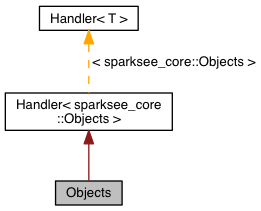
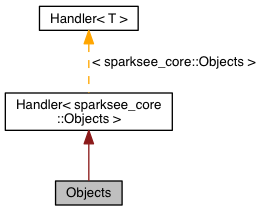
Object identifier set class. More...
#include <Objects.h>
Public Member Functions | |
| virtual | ~Objects () |
| Destructor. | |
| Objects * | Copy () |
| Creates a new Objects instance as a copy of the given one. | |
| int64_t | Count () |
| Gets the number of elements into the collection. | |
| bool_t | Add (oid_t e) |
| Adds an element into the collection. | |
| bool_t | Exists (oid_t e) |
| Gets if the given element exists into the collection. | |
| oid_t | Any () throw (sparksee::gdb::NoSuchElementException, sparksee::gdb::Error) |
| Gets an element from the collection. | |
| bool_t | Remove (oid_t e) |
| Removes an element from the collection. | |
| void | Clear () |
| Clears the collection removing all its elements. | |
| int64_t | Union (Objects *objs) |
| Performs the union operation. | |
| int64_t | Intersection (Objects *objs) |
| Performs the intersection operation. | |
| int64_t | Difference (Objects *objs) |
| Performs the difference operation. | |
| bool_t | Equals (Objects *objs) |
| Checks if the given Objects contains the same information. | |
| bool_t | Contains (Objects *objs) |
| Check if this objects contains the other one. | |
| int64_t | Copy (Objects *objs) |
| Performs the copy operation. | |
| Objects * | Sample (Objects *exclude, int64_t samples) |
| Creates a new Objects instance which is a sample of the calling one. | |
| ObjectsIterator * | Iterator () |
| Gets an ObjectsIterator. | |
| ObjectsIterator * | IteratorFromIndex (int64_t index) |
| Gets an ObjectsIterator skipping index elements. | |
| ObjectsIterator * | IteratorFromElement (oid_t e) |
| Gets an ObjectsIterator starting from the given element. | |
Static Public Member Functions | |
| static Objects * | CombineUnion (Objects *objs1, Objects *objs2) |
| Creates a new Objects instance which is the union of the two given. | |
| static Objects * | CombineIntersection (Objects *objs1, Objects *objs2) |
| Creates a new Objects instance which is the intersection of the two given. | |
| static Objects * | CombineDifference (Objects *objs1, Objects *objs2) |
| Creates a new Objects instance which is the difference of the two given. | |
Static Public Attributes | |
| static const oid_t | InvalidOID |
| Invalid OID constant. | |
Friends | |
| class | Session |
| class | Graph |
| class | ObjectsIterator |
Detailed Description
Object identifier set class.
It stores a collection of Sparksee object identifiers as a set. As a set, there is no order and no duplicated elements.
This class should be used just to store large collections. Otherwise, it is strongly recommended to use common classes from the language API.
This class is not thread-safe.
ObjectsIterator must be used to traverse all the elements into the set.
When the Objects instance is closed, it closes all existing and non-closed ObjectsIterator instances too.
Member Function Documentation
◆ Add()
Adds an element into the collection.
- Parameters
-
e [in] Element to be added.
- Returns
- TRUE if the element is added, FALSE if the element was already into the collection.
◆ Any()
| oid_t Objects::Any | ( | ) | ||||
| throw | ( | sparksee::gdb::NoSuchElementException, | ||||
| sparksee::gdb::Error ) | ||||||
Gets an element from the collection.
- Returns
- Any element from the collection.
- Exceptions
-
NoSuchElementException whether the collection is empty. Error for other issues.
◆ CombineDifference()
Creates a new Objects instance which is the difference of the two given.
Two given Objects belong to the same Session.
- Returns
- New Objects instance.
References CombineDifference().
Referenced by CombineDifference().
◆ CombineIntersection()
Creates a new Objects instance which is the intersection of the two given.
Two given Objects belong to the same Session.
- Returns
- New Objects instance.
References CombineIntersection().
Referenced by CombineIntersection().
◆ CombineUnion()
Creates a new Objects instance which is the union of the two given.
Two given Objects belong to the same Session.
- Returns
- New Objects instance.
References CombineUnion().
Referenced by CombineUnion().
◆ Contains()
Check if this objects contains the other one.
- Parameters
-
objs Objects collection.
- Returns
- True if it contains the given object.
References Contains().
Referenced by Contains().
◆ Copy() [1/2]
| Objects * Objects::Copy | ( | ) |
◆ Copy() [2/2]
◆ Count()
| int64_t Objects::Count | ( | ) |
Gets the number of elements into the collection.
- Returns
- The number of elements into the collection.
◆ Difference()
Performs the difference operation.
This updates the Objects calling instance removing those existing elements at the given Objects instance.
- Parameters
-
objs [in] Objects instance.
- Returns
- Number of elements into the collection once the operation has been executed.
References Difference().
Referenced by Difference().
◆ Equals()
◆ Exists()
Gets if the given element exists into the collection.
- Parameters
-
e [in] Element.
- Returns
- TRUE if the element exists into the collection, FALSE otherwise.
◆ Intersection()
Performs the intersection operation.
Updates the Objects calling instance setting those existing elements at both two collections and removing all others.
- Parameters
-
objs [in] Objects instance.
- Returns
- Number of elements into the collection once the operation has been executed.
References Intersection().
Referenced by Intersection().
◆ Iterator()
| ObjectsIterator * Objects::Iterator | ( | ) |
Gets an ObjectsIterator.
- Returns
- ObjectsIterator instance.
References Iterator().
Referenced by Iterator().
◆ IteratorFromElement()
| ObjectsIterator * Objects::IteratorFromElement | ( | oid_t | e | ) |
Gets an ObjectsIterator starting from the given element.
Objects collection has no order, so this method is implementation-dependent.
- Parameters
-
e [in] The first element to traverse in the resulting ObjectsIterator instance.
- Returns
- ObjectsIterator instance.
References END_SPARKSEE_GDB_NAMESPACE, and IteratorFromElement().
Referenced by IteratorFromElement().
◆ IteratorFromIndex()
| ObjectsIterator * Objects::IteratorFromIndex | ( | int64_t | index | ) |
Gets an ObjectsIterator skipping index elements.
Objects collection has no order, so this method is implementation-dependent.
- Parameters
-
index [in] The number of elements to skip from the beginning. It must be in the range [0..Size).
- Returns
- ObjectsIterator instance.
References IteratorFromIndex().
Referenced by IteratorFromIndex().
◆ Remove()
◆ Sample()
Creates a new Objects instance which is a sample of the calling one.
- Parameters
-
exclude [in] If not NULL, elements into this collection will be excluded from the resulting one. samples [in] Number of elements into the resulting collection.
- Returns
- Sample collection.
References Sample().
Referenced by Sample().
◆ Union()
The documentation for this class was generated from the following file: